Forget the Prius analogy—this isn’t about fuel efficiency. We’re talking about the power grid’s ultimate dynamic duo. Imagine Batman’s endurance paired with Robin’s lightning reflexes. That’s the essence of a hybrid storage approach.
At its core, it’s an intelligent marriage. Different energy storage technologies—like the quick-draw supercapacitor and the marathon-running battery—join forces in one coordinated system. Each handles what it does best.
One component tackles sudden, high-power demands. Another manages long, steady energy needs. Together, they create something greater than the sum of their parts.
The National Renewable Energy Laboratory sees this as part of a bigger picture. Solar panels and wind turbines now cozy up with these multi-technology setups. They form integrated power plants that are key to our future grid.
This isn’t engineering for its own sake. It’s a strategic move toward maximum efficiency and cost savings. As with any promising partnership, though, the magic is in the details. Properly modeling these combined systems is where the real challenge—and opportunity—lies.
Combining Technologies for Efficiency
Forget shotgun weddings between energy technologies—successful hybrids require carefully arranged marriages based on complementary traits. You wouldn’t pair a marathon runner with a sprinter for a relay race without a strategy. The goal isn’t just to have two storage methods in the same room. It’s to engineer a partnership where one’s weakness is the other’s superpower.
This is where the classic battery + supercapacitor duo shines. Think of it as a cinematic buddy-cop pairing. The battery is your seasoned detective with incredible stamina (high energy density). It can work a long case but hates sudden, violent chases. The supercapacitor is the hotshot rookie—explosive speed and power, perfect for those intense bursts. By letting the supercap handle the rapid charge-discharge cycles, you save the battery from unnecessary wear and tear.
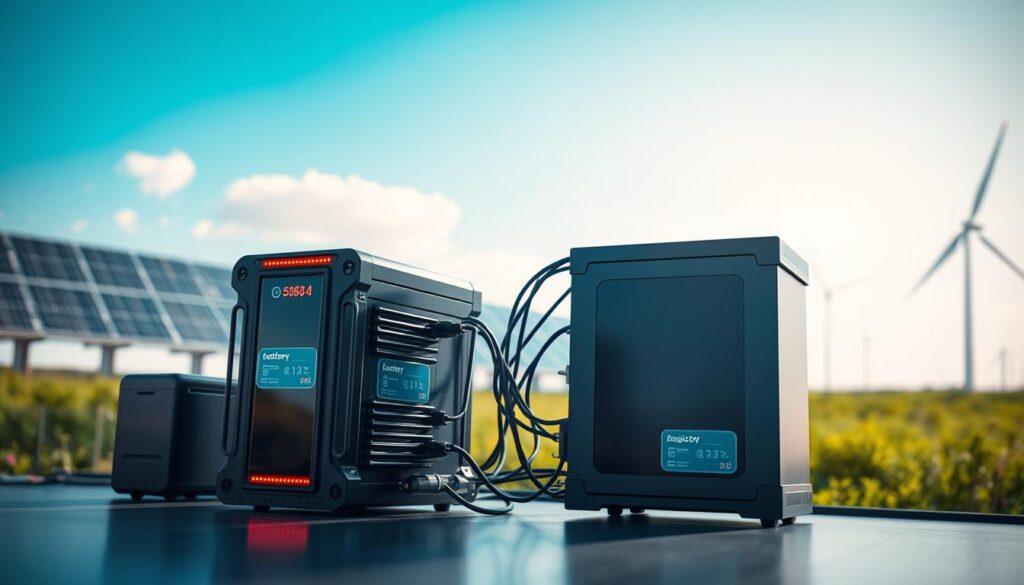
The result? Extended battery life and a more resilient system. It’s not just theory. This combo is proving its worth in applications from regenerative braking in electric vehicles to smoothing out solar power fluctuations. The economics improve because you’re not constantly replacing tired batteries.
To understand these partnerships, we need to look at what each technology brings to the table. Not all storage is created equal. Some excel at holding lots of energy for a long time. Others are champions of delivering massive power in an instant. The table below breaks down the core families of storage tech and their personality traits.
| Technology Type | Key Strength | Key Weakness | Ideal Hybrid Partner |
|---|---|---|---|
| Chemical (Batteries) | High energy density, long storage period | Slow reaction time, limited cycle life | Supercapacitor, Flywheel |
| Electrical (Supercapacitors) | Extreme power density, instant reaction | Low energy density, high self-discharge | Battery, Compressed Air |
| Mechanical (Flywheels) | Very high efficiency, excellent for frequency regulation | Short storage period, complex maintenance | Battery, Thermal Storage |
| Thermal (Molten Salt, Ice) | Very low cost for large-scale, long duration | Slow reaction time, geographic limitations | Battery, Superconducting Magnet |
This isn’t a lonely hearts club. The battery + supercapacitor is just one famous power couple. Other compelling matches are making waves. A superconducting magnet paired with a battery balances insane power density with practical discharge times. Flywheels and batteries team up for grid frequency regulation—the flywheel handles the second-by-second jitters while the battery manages the minute-to-minute swings.
Then there’s the odd couple: compressed air and supercapacitors. The compressed air provides cheap, bulk storage. The supercapacitor offers the lightning-fast response needed to inject or absorb power during rapid grid transitions. It’s a surprisingly effective match.
But hardware pairing is only half the story. True efficiency comes from how they’re connected and managed. Take solar power. A DC-coupled PV+battery hybrid uses a shared inverter. This isn’t just about saving money on hardware (though that’s a nice perk). It creates a direct, efficient highway for solar energy to charge the battery. No detour through the AC grid with its conversion losses.
Research from places like NREL shows this operational synergy is a game-changer. The battery charges from excess local solar generation at peak efficiency. When the sun sets, it’s ready to go. This co-optimization—sizing and operating the pair as a single, intelligent unit—is the secret sauce. It maximizes the net economic benefit, turning a good idea into a smart investment.
The future of resilient energy relies on these integrated systems. It’s about moving beyond simple addition. The winning strategy is to build alliances where the whole is genuinely greater than the sum of its parts. That’s where real efficiency—and real value—is born.
Application Examples
Forget lab coats and whiteboards—the real test for hybrid storage happens where megawatts meet market forces. The theory is elegant, but applications are where electrons earn their keep. Let’s tour the front lines.
Start in sun-drenched Southern Europe. Spain’s solar farms face a problem: cannibalization. This isn’t the kind with cutlery. It’s when everyone’s panels produce at the same time, flooding the market and crashing prices. The midday sun becomes a revenue black hole.
Enter the solar-plus-storage hybrid. It acts as a savvy day trader. It soaks up cheap midday surplus. Then, it releases it during the premium evening hours when demand spikes and solar fades. This isn’t just efficiency; it’s economic jiu-jitsu. The same story unfolds in Germany, where the Innovation Tender rewards projects that pair generation with storage, creating a policy-driven proving ground.
Now, hop over to Poland. Here, the challenge isn’t just economics—it’s physics and paperwork. Securing a grid connection for a standalone solar project can feel like waiting for a table at the trendiest restaurant in town. The grid is congested.
But propose a solar-plus-storage hybrid? Suddenly, you’re not a problem; you’re a solution. By smoothing its own output and supporting the grid, the hybrid becomes a grid integration passport. It’s a ticket to participate in Poland’s capacity market—a kind of insurance auction for future power needs—and ancillary services markets. The hybrid storage system turns a grid connection hurdle into a revenue opportunity.
Zoom out to the grid operator’s control room. Their perspective is system-wide. Research from the National Renewable Energy Laboratory (NREL) models the benefits of a fleet of PV-battery hybrids. The findings are compelling.
- Increased Inverter Utilization: The same hardware does double duty, converting power for both immediate use and later dispatch.
- Reduced Grid Stress: By minimizing charging from the grid during peak times, hybrids ease congestion.
- Lower System-Wide Costs: They reduce the need to fire up expensive, polluting “peaker” plants.
This isn’t just about one project’s bottom line. It’s about making the entire grid cheaper and more resilient. From the deserts of California to the plains of Texas, this system-level thinking is driving adoption. Hybrid energy storage systems are proving to be the versatile Swiss Army knife of the clean energy transition.
So, what’s the common thread? Whether dodging price cannibalism, navigating grid queues, or answering a grid operator’s plea for stability, hybrid storage provides context-specific answers. It’s the ultimate pragmatist in an idealistic energy revolution. The applications will only multiply as markets evolve. The question is no longer “if” but “where next?”
Pros and Cons
Hybrid systems promise a lot, but the reality is complex. It’s like trying to make a marriage work—sometimes it’s great, sometimes it’s not. The outcome depends on how well the parts work together.
The good news is that hybrid systems offer many benefits. For example, pairing technologies can create new capabilities. A battery + supercapacitor system lets each part do its best job.
The battery stores energy for a long time, while the supercapacitor handles quick charges and discharges. This teamwork makes equipment last longer. It’s like having a team of runners instead of one trying to do it all.
Hybrid systems also save money. Research shows they can make projects safer and open up new income streams. This means better returns for investors and a more stable grid.
Solar energy capture gets better, and connecting to the grid is easier. Costs go down as efficiency goes up. It’s like getting the best of both worlds—until you remember there are always downsides.
But there are downsides to consider. The first is that our models don’t always get it right. NREL says there’s a gap between what models predict and what actually happens.
This means we’re not yet sure how valuable hybrids really are. It depends on the design and location. It’s a bit like trying to predict the weather.
Hybrids can sometimes make things worse, not better. If not set up right, they might miss out on cheap power. This can save money on hardware but limit flexibility.
The decision to use hybrids depends a lot on the site. DNV says adding a BESS to a solar project might not be worth it if congestion is short-lived. Sometimes, simpler projects can be more effective.
Policy also plays a big role. In Germany, for example, rules can limit how hybrids work. The rules matter as much as the technology.
So, hybrids are not always the best choice. The battery + supercapacitor combo is promising, but it needs careful planning. For a detailed look at the pros and cons, check out this analysis.
The truth is, hybrids can be a game-changer or a costly mistake. Knowing the difference is key to success. It’s all about understanding the risks and rewards before you start.
Future Outlook
So, what’s next for our hero, hybrid storage? The future is full of possibilities. It’s a mix of wires, policies, and real-world tests. Places like NREL’s ARIES will help us move from theory to reality.
Systems with storage are now 94% reliable during outages. Costs for backup have dropped 40% from 2020. This isn’t just about tech. It’s about having a reliable backup you can count on, with payback in under eight years.
The outlook is even better. To reach net-zero, we need 20 times more solar power. Rooftop panels can cut CO2 by about 1.5 tonnes per home yearly. Large solar farms also play a role. But we need smart management to make it all work. That’s where advanced hybrid storage systems come in.
Community solar projects could power 30 million homes by 2030. They offer savings without the need for home panels. This growth depends on grids that can handle decentralized power. Hybrid storage is key to making this new, democratic grid work.
Our models are getting better. Our hardware is getting stronger. The talk is moving from “if” to “how fast” on solar adoption. The future of energy is a clever mix of sources, not just one.
Check out the sunshine status of solar adoption for more insights.