Let’s start at the end. Because for most of the power cells fueling our electric dreams, that’s where they end up.
It’s a story we’ve all heard before: extract, use, and then throw away. We create these wonders in huge factories, only to discard them like yesterday’s trash. It’s not exactly the most eco-friendly approach.
This isn’t just a eulogy for old lithium-ion, though. It’s a warning. We’re going to explore the whole life of a storage battery, from start to finish. It’s like a deep dive into the heart of the energy shift.
Why is its current story a tale of waste? And how can we turn it into a story of rebirth? The growing waste from electric cars and energy storage is a big problem. It’s a strategic mistake. In the game of resource management, losing your best pieces is a bad move.
We’re on the verge of a circular revolution. Where the end of one chapter is the start of another. For more on how this works, check out the EV battery lifecycle explained.
Recycling Technology
Modern battery recycling has moved from sledgehammers to spectrometers. It’s now a sophisticated chemical process. This is the heart of a real circular economy.
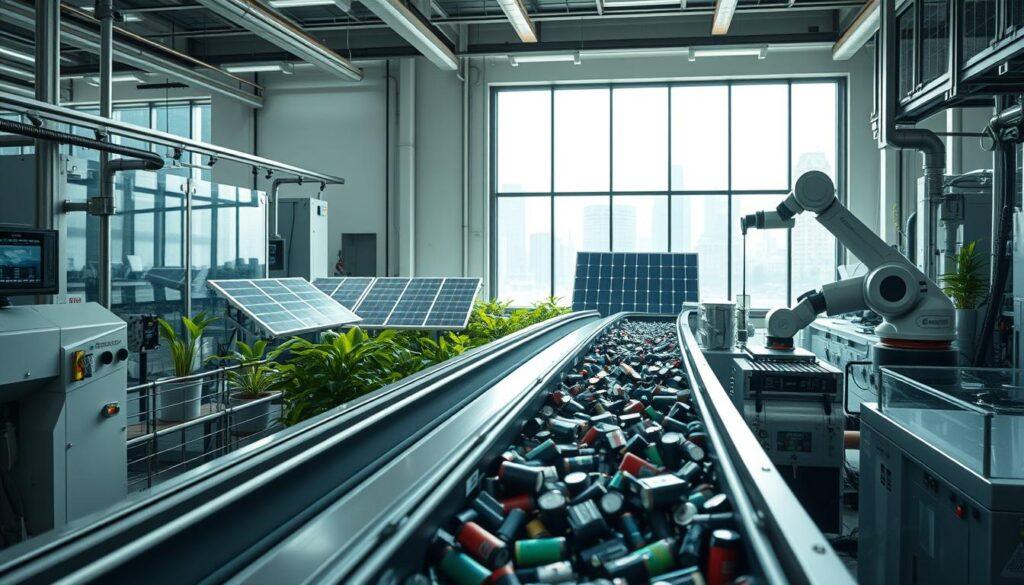
The industry uses three main methods. Each method is like a different chef making the same dish.
Pyrometallurgy uses high heat to melt everything down. It recovers metals but loses the cathode structure. It’s effective but rough.
Hydrometallurgy uses chemical baths to dissolve and recover metals. It’s precise and common, saving more value than pyrometallurgy. It’s the most skilled chef.
Direct Regeneration tries to restore the spent cathode material. It’s a gentle chemical refresh. It’s the most efficient method but is in the early stages.
Each method has its own way of closing the loop in a circular economy. The goal is to get the right stuff back in a usable form.
Green Li-ion is a rockstar in this field. They’ve created modular systems that turn “black mass” into 99% pure pCAM. It’s like a micro-brewery for battery ingredients, making production more local.
This model could change the circular economy by processing waste locally. Companies like Fluence are partnering with recyclers like Li-Cycle, which recovers 95% of all battery chemistries.
But there’s a big question. What about LFP batteries? They’re cheaper, safer, and cobalt-free. But their lower value materials make recycling less profitable.
If recycling can’t make money, the technology won’t grow. We need new ways to make LFP recycling work. This could include subsidies, regulations, or new material recapture strategies.
The real test of our circular economy is the cheap, common batteries. That’s where the challenge lies.
Regulatory Frameworks
Imagine trying to build IKEA furniture without the manual. That’s what battery recycling is like without rules. You have all the parts, but without clear instructions, it’s hard to start.
Today, places like the European Union, Japan, and China have strong recycling rules. But in other areas, it’s like the Wild West.
The EU is like a strict but caring parent. They make producers take care of their products after use. This idea, called Extended Producer Responsibility (EPR), is spreading worldwide.
Deposit-return schemes are also becoming popular. You pay a bit more for a battery, and get it back when you return it. It makes recycling a real transaction.
The digital product passport is a new idea. It’s like a medical chart for batteries, showing what they’re made of and how they were made. This helps recycling facilities sort batteries quickly and accurately.
The world has two main ways of handling recycling:
- The Preemptive Regulators (EU, China): They set clear rules and goals for recycling.
- The Market-Led Evolvers (Parts of the U.S.): They let the market and states lead, hoping for innovation.
This mix of rules is hard for big companies to follow. Our battery recycling regulations compliance guide helps explain it.
Clear rules are important for a circular economy. They help attract investment in recycling and make sure everyone plays by the same rules.
Places with strong recycling laws see big improvements. Collection rates go up from single digits to over 50% in a few years. This is thanks to good policies.
The Illinois Energy Association shows how rules help everyone. They make recycling easier for utilities and consumers.
Technology helps us recycle batteries, but rules tell us why and when. Without rules, recycling is just a hobby. Places with good rules will be more efficient and resilient in the future.
Corporate Responsibility
If you think corporate responsibility is just PR fluff, you haven’t seen what happens when Tesla turns its trash into treasure. The game has changed. Today’s smartest companies aren’t just checking boxes for their sustainability reports. They’re building competitive moats from their own waste streams.
This shift transforms end-of-life management from a cost center into a strategic asset. Source 1 frames closed-loop recycling as a pure economic advantage. It offers manufacturers supply stability and cost control in a volatile market for critical minerals. Why dig new holes when you can mine the urban landscape you’ve already created?
Take Tesla’s 2023 operations. The company recovered enough battery material to build approximately 43,000 Model Y vehicles. That’s not charity. That’s a supply chain strategy disguised as environmentalism. They’re not just making cars. They’re creating a perpetual motion machine for valuable metals.

Other players are weaving responsibility into their DNA from day one. Fluence takes a holistic approach. They regionalize manufacturing to cut transport emissions. They implement a responsible sourcing framework for raw materials. Most importantly, they mandate recycling partnerships with specialists like Li-Cycle.
Fluence builds decommissioning procedures into its storage systems at the design phase. This isn’t an afterthought. It’s a core product feature. Their internal policies for end-of-life management turn possible liability into customer assurance and material recovery.
Then there’s the brilliant second-life play. The collaboration between Audi and RWE created a 4.5 MWh energy storage system from 60 retired EV batteries. This pioneering project proves that “waste” is merely a resource in the wrong place. It extends battery utility and delays recycling needs.
These examples reveal a new corporate calculus. The circular economy is no longer a niche concept. It’s a boardroom strategy for resource security and brand resilience. Companies that master this will control their destinies.
| Company/Initiative | Core Strategy | Key Metric/Example | Circular Economy Impact |
|---|---|---|---|
| Tesla | Closed-loop recycling at scale | Material recovered for ~43,000 vehicles (2023) | Direct recapture of lithium, cobalt, nickel |
| Fluence | Designing for decommissioning | Mandatory recycling partnerships (e.g., Li-Cycle) | Full lifecycle responsibility from installation |
| Audi-RWE Project | Second-life application development | 4.5 MWh storage from 60 retired EV packs | Extends useful life, defers recycling burden |
| Industry Benchmark | Urban mining & material sovereignty | Shift from cost center to revenue stream | Creates domestic, secure material supply chains |
The sage advice for today’s executive is simple. Your most valuable mine isn’t in a remote desert. It’s in the parking lots, garages, and grid storage sites filled with your products. The companies brave enough to dig through their own trash will find the treasure that fuels their future.
Corporate responsibility in the battery sector has shed its oxymoron status. It’s now the hallmark of intelligent, forward-thinking business. The race isn’t just to build better batteries. It’s to build a system where every battery’s end is another’s beginning.
Industry Trends
The future of batteries isn’t just about electric vehicles. It’s about finding new uses for old batteries. A battery might power your car for ten years. Then, it could help stabilize the grid for another decade.
This means batteries will have a second life. They will be used in new ways, thanks to second-life applications. This delays when a battery is retired.
The battle over battery chemistry is changing everything. LFP batteries, with less cobalt and more graphite, are becoming more popular. This change forces the battery recycling world to adapt.
It’s a big shift, moving from focusing on rare metals to recycling iron and carbon. Sodium-ion batteries are also on the horizon. They could make batteries even more sustainable.
This change needs a new way of working together. The key trend isn’t a new technology. It’s a new way of thinking. We’re moving from owning batteries to taking care of them forever.
This shift is essential. It ensures batteries can power our future without harming the planet. True battery recycling is the only way to make this happen.