Let’s talk about the elephant in the room – or the gust that isn’t always there when you need it. Renewable energy’s biggest strength is also its biggest weakness: it’s not always consistent.
It’s like having a brilliant but unreliable friend who shows up with amazing ideas at 3 AM when you’re trying to sleep. The storage challenge isn’t just about finding a place to stash excess energy.
It’s about solving the temporal mismatch between when the wind blows and when we actually need electricity. Without proper storage, renewable power is like having a sports car you can only drive when weather permits.
This section explores why storing wind energy isn’t just nice to have – it’s absolutely essential for grid reliability. The right solutions can turn nature’s unpredictability into our greatest asset.
Types of Energy Storage Used
Welcome to the energy storage buffet – where the options are diverse and the choices matter more than you’d think. Choosing the right energy storage is like picking your fantasy football lineup. Each option has different strengths, and the right combination can make or break your season.
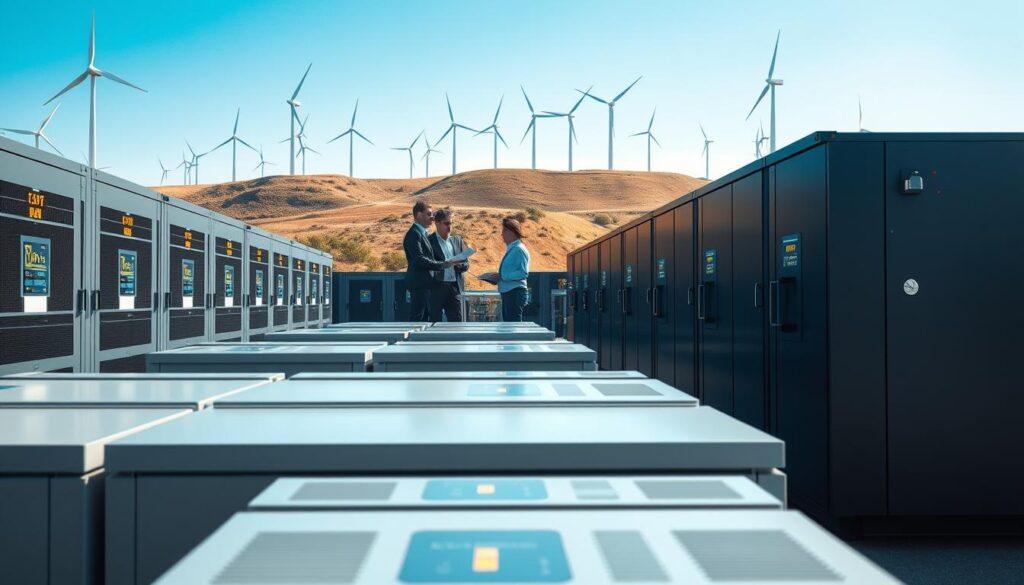
Battery Storage System
Battery storage systems are the rockstars of energy storage. They’re versatile, scalable, and getting cheaper by the minute. Lithium-ion batteries are the most popular, while flow batteries offer long-lasting endurance.
These systems respond quickly and can be used almost anywhere. They’re great for smoothing out unpredictable wind patterns, making forecasting easier.
Pumped Hydro Storage
Pumped hydro storage has been around for over a century. It’s like the Mick Jagger of energy storage – always rocking. This technology uses two water reservoirs to store energy, pumping water uphill when there’s too much and releasing it downhill when needed.
It’s the workhorse of large-scale storage, making up over 90% of global capacity. But, you need specific geography and deep pockets for construction.
Compressed Air Energy Storage
Compressed air storage is like a pneumatic savings account for energy. During excess wind power, air is compressed and stored in underground caverns or tanks. When demand peaks, this air is released to drive turbines and generate electricity.
It’s the middle child of energy storage – not as flashy as batteries, not as established as pumped hydro, but quietly effective in the right circumstances.
Flywheel Energy Storage
Flywheel systems spin energy into kinetic gold. They store energy in a rotating mass, maintaining constant motion in a vacuum to minimize friction. When the grid needs power, the flywheel’s rotation slows down, converting kinetic energy back to electricity.
They’re the precision engineers of the storage world – excellent for frequency regulation and short-duration backup power. Think of them as the energy storage equivalent of a Formula 1 pit crew: incredibly fast and precise, but not built for marathon sessions.
| Storage Technology | Response Time | Duration Capacity | Best Application |
|---|---|---|---|
| Battery Systems | Milliseconds | Hours | Frequency regulation, short-term backup |
| Pumped Hydro | Minutes | Days | Large-scale energy shifting |
| Compressed Air | Minutes | Hours | Medium-scale storage |
| Flywheel | Seconds | Minutes | Frequency stabilization |
Each technology brings something unique to the table. The key is understanding which solution fits your specific needs – because in the energy world, there’s no one-size-fits-all solution. For a deeper dive into how these systems integrate with wind turbines, check out our guide on energy storage systems for wind turbines.
Integration with Other Renewables
Wind energy’s biggest plus is also its biggest challenge for grid managers. It’s like trying to run an orchestra where the wind section plays on its own. Add solar’s daily pattern and hydro’s steady beat, and you get a mix that needs a conductor.
That conductor is energy storage. It’s the behind-the-scenes manager that makes this renewable mix work well together.
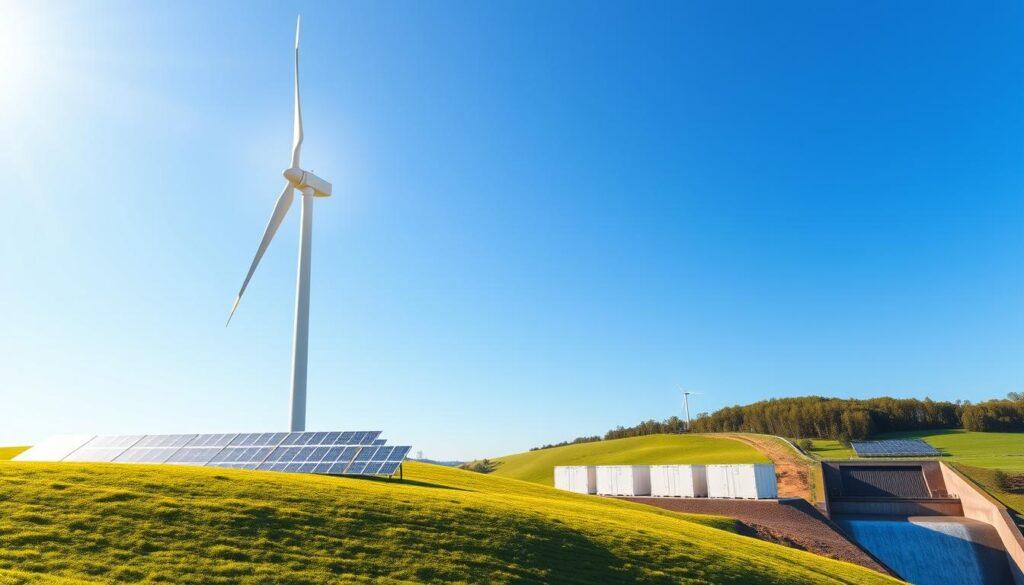
Storage doesn’t just fix wind’s unpredictable moments. It also makes sure all technologies work together smoothly. When solar shines during the day and wind plays at night, storage keeps the energy flowing. On calm days, stored energy from before keeps the lights on.
This integration turns renewable sources into a single, strong team. The magic comes from three main things:
- Time-shifting generation from peak production to peak demand
- Providing ancillary services that keep the grid stable
- Balancing intermittent supply with consumption patterns
Think of it as renewable energy’s ultimate collaboration album. Solar shines during the day, wind plays at night, and storage keeps the flow going.
The real beauty of this integration? It makes a strong, resilient energy system. Wind and solar work together, with hydro’s steady beat backing them up. And storage? It’s the producer that makes the whole album a hit.
| Renewable Source | Production Pattern | Storage Integration Role | Grid Value Added |
|---|---|---|---|
| Wind Power | Intermittent, often nocturnal | Captures excess night generation | Provides evening peak support |
| Solar Energy | Predictable daytime | Stores midday surplus | Extends availability past sunset |
| Hydroelectric | Consistent, dispatchable | Complements short-term gaps | Provides baseline reliability |
| Geothermal | 24/7 availability | Minimal storage needs | Anchor for renewable mix |
This advanced renewable integration lets us use more clean energy without losing grid stability. It’s not just about adding more green energy. It’s about making a smarter, more flexible system that can handle life’s ups and downs.
The future of energy isn’t about choosing between renewables. It’s about creating a supergroup where storage makes sure every member shines at the right time.
Recent Innovations
Finnish researchers are making waves in energy storage. They’re using thermal sand batteries to store heat at 500°C for months. This is a new way to store renewable energy, far from traditional batteries.
These innovations are exciting because they tackle the big problem of wind storage. They help keep the lights on even when the wind isn’t blowing. The development is happening fast, like a turbine in a hurricane.
- Thermal sand batteries – Using common sand to store heat at extreme temperatures
- Liquid air energy storage – Sounds like science fiction but works like physics magic
- Gravity storage systems – Uses massive weights for energy storage
- Advanced flow batteries – Chemical storage that doesn’t degrade over time
- Underground hydrogen storage – Powers the future beneath our feet
The real breakthrough is making these technologies practical and scalable. Companies like Enercon are integrating these innovations into networked energy systems. It’s like something out of a Tony Stark movie.
What’s most fascinating? These aren’t just lab experiments anymore. They’re becoming commercially viable fast. The combination of wind power and advanced storage is changing how we view energy reliability.
The future of wind storage is here, and it’s full of innovation. These technologies are not just pushing limits. They’re rewriting the energy map.
Economic and Policy Considerations
Storage costs have plummeted like a bad tweet during a crisis. Battery prices dropped nearly 90% in the past decade. This has turned storage into a no-brainer for wind projects.
These batteries slash electricity bills by avoiding peak rates and selling power when it’s most valuable. They optimize wind energy use, reducing waste and boosting profits.
But economics alone won’t save us. Policy is the puppet master here. Tax credits, renewable mandates, and market rules dictate if storage thrives or dies. Without smart regulations, even the cheapest batteries gather dust.
The future hinges on this duo: falling costs and forward-thinking policies. Get it right, and we secure a resilient, affordable grid. Miss the mark, and we’re just blowing in the wind.