Ever wondered how we harness wind power in deep ocean areas? It’s not magic. It’s engineering that would impress even Tony Stark.
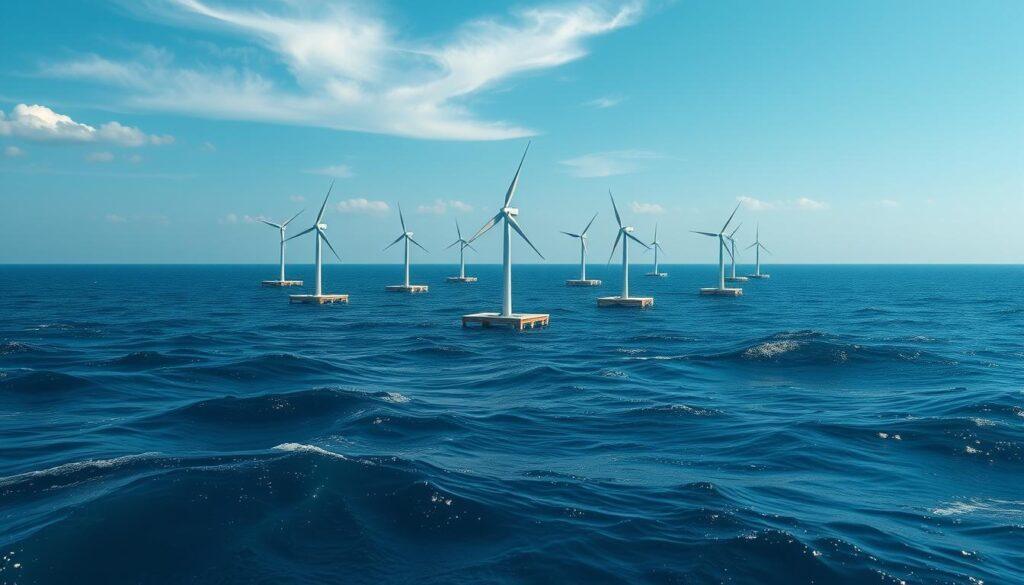
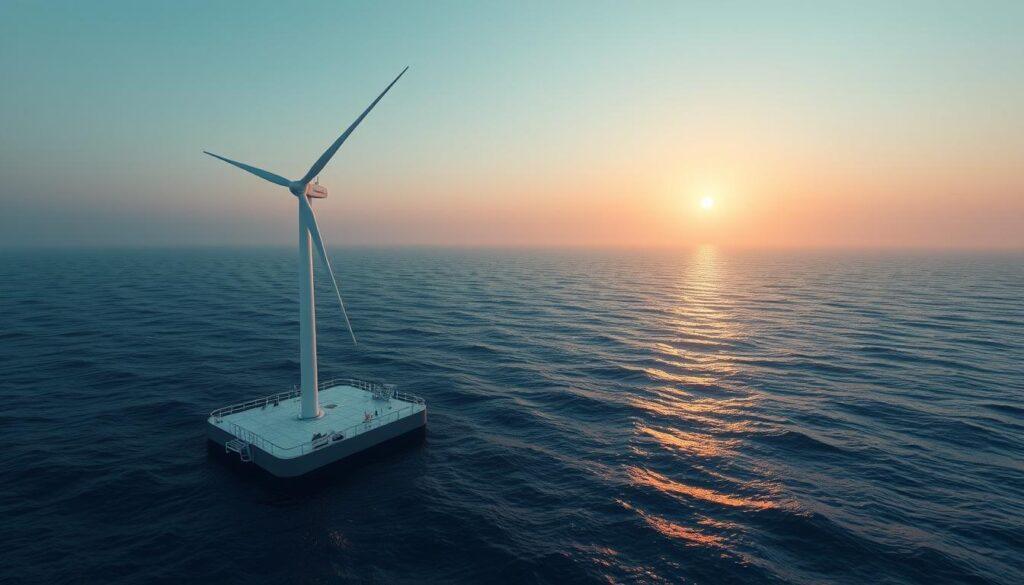
These huge structures move on waves thanks to three smart designs. The spar-buoy acts like a deep-sea pendulum. The semi-submersible spreads its weight evenly, like a balanced dinner party. And the tension-leg platform uses strong cables, tighter than a Broadway show’s plot.
The mooring systems are the real heroes. They use heavy-duty chains and cables to keep these giants steady during storms.
It’s like trying to tame Poseidon, but with better engineering and fewer tantrums. These floating turbines are at the forefront of renewable energy today.
Key Projects and Pilots
Most energy innovations start in labs, but floating wind technology skipped that step. It went straight to the open ocean. The proof is in the wind farms spinning in deep waters from Scotland to Japan.
Scotland’s Hywind project was the first commercial floating wind farm in 2017. It quietly powered 20,000 homes while skeptics debated its feasibility. Five turbines, 78 meters tall, danced with North Sea waves, showing deepwater wind is not just possible but profitable.
Portugal’s WindFloat Atlantic followed with elegance. It powers 60,000 households with a technology that handles Atlantic swells like a pro. This shows stability in floating wind technology.
Japan’s Fukushima FORWARD project tested floating wind technology near a region known for energy challenges. It serves as a technological testbed and a symbol of rebirth. Innovation can emerge from adversity.
France’s EFGL project wanted to do more than just generate clean energy. It wanted to throw an underwater party. This nature-inclusive floating wind farm enhances marine biodiversity through artificial habitats called Biohuts. It’s like installing five-star hotels for fish while harvesting megawatts from the wind.
These projects are more than just technological demonstrations. They show our energy future isn’t tied to continental shelves. As these floating offshore wind pilot projects prove their worth, they’re changing the rules of renewable energy harvesting.
| Project | Location | Capacity | Unique Feature | Homes Powered |
|---|---|---|---|---|
| Hywind Scotland | North Sea | 30 MW | World’s first commercial floating farm | 20,000 |
| WindFloat Atlantic | Portugal | 25 MW | Semi-submersible platform technology | 60,000 |
| Fukushima FORWARD | Japan | 16 MW | Post-disaster energy innovation symbol | 10,000 |
| EFGL France | Mediterranean | 30 MW | Biohuts for marine biodiversity | 50,000 |
The data shows these aren’t science experiments but viable energy solutions. Each project tackles different challenges. Together, they prove deepwater wind technology has moved from concept to reality.
These projects turned weaknesses into strengths. Floating platforms access stronger, more consistent winds further offshore. They avoid visual pollution near coastlines. And the French project shows they can enhance marine ecosystems.
The real genius is these pioneers have paved the way for future projects. They’ve tested different technologies and approaches. Their experience will guide the next generation of deepwater wind development.
While fixed-bottom offshore wind gets headlines, these floating projects are quietly building the future. They show we’re not limited by water depth or seabed conditions. Our renewable energy future can float wherever the wind blows strongest.
Overcoming Engineering Barriers
Designing floating wind turbines is like trying to put together IKEA furniture while skydiving. The instructions are not clear. These turbines face harsh conditions that make even seasoned sailors feel uneasy. How do we keep them working in such tough places?
Maintenance is a huge challenge. Imagine needing to tow your whole office back to shore because the coffee machine broke. It’s not just inconvenient; it’s a huge logistical problem that needs military precision.
Underwater cabling is another engineering challenge. We’re talking about power lines that are like transatlantic communications cables. These lines must handle crushing depths, corrosive saltwater, and constant motion.
The real drama is in the design arena. Three competing platforms are fighting for dominance:
| Design Type | Stability Approach | Best For | Complexity Level |
|---|---|---|---|
| Spar-Buoy | Deep draft counterweight | Deep waters | High |
| Semi-Submersible | Multiple pontoons | Various depths | Medium |
| Tension-Leg Platform | Vertical tension cables | Moderate depths | Extreme |
Platform stability is more than just staying upright. It’s about controlling motion like a Hollywood stunt. These systems must dampen pitch, roll, and heave motions while keeping turbines in the best position for energy capture.
The innovation here is more than just small improvements. According to NREL’s analysis, we’re seeing major breakthroughs in materials science, hydrodynamic modeling, and remote monitoring systems.
What makes this innovation impressive? These solutions must be:
- Cost-effective despite extreme conditions
- Reliable with minimal human intervention
- Scalable for mass deployment
- Environmentally sustainable
The solutions we’re seeing are more than just technical achievements. They’re changing what’s possible in renewable energy. Each solved problem has effects across multiple industries, from marine engineering to robotics.
This isn’t just about building better turbines. It’s about creating systems that can thrive in places where others barely survive. The engineering barriers are not obstacles; they’re opportunities for grand innovation.
Market Potential
Let’s talk numbers – because nothing gets investors more excited than the sound of profit meeting planetary salvation. The market for floating turbines is promising, almost screaming “opportunity of the century.”
We’re seeing cost reductions of up to 70% by 2030. This means “start investing yesterday.” It’s not just speculation; it’s based on real tech advancements and scaling effects.
Europe plans to install 10 GW of floating wind by 2030. This will power 10 million homes and make fossil fuel executives nervous. This shift in energy infrastructure is happening fast.
The real game-changer is floating wind technology. It unlocks 80% of Europe’s offshore wind resources, previously unreachable. This is like discovering new oil fields, but cleaner and smarter.
The US West Coast is also getting into the game with 2 GW projects. California and Oregon are leading, aiming to power cities with ocean breezes.
According to market analysis, the global floating offshore wind market is set for explosive growth. The numbers show it’s one of the most promising renewable energy sectors of the next decade.
| Region | Projected Capacity by 2030 | Key Market Drivers | Primary Challenges |
|---|---|---|---|
| Europe | 10 GW | Deep water resources, EU climate targets | Grid connectivity, supply chain scaling |
| United States (West Coast) | 2-3 GW | State renewable mandates, deep water access | Regulatory approval, port infrastructure |
| Asia-Pacific | 3-4 GW | Growing energy demand, coastal population centers | Typhoon resilience, manufacturing capacity |
| Global Total | 15-17 GW | Cost reduction trajectory, technology maturation | Financing models, standardization |
The economic implications are huge. We’re talking about clean energy, job creation, technology exports, and energy security. Floating offshore wind is the perfect mix of environmental responsibility and economic sense.
This market is exciting because of the timing. As traditional energy faces volatility and climate pressures, floating turbines offer stability. They’re not as price-sensitive as fossil fuels, making them attractive to utilities and corporations.
The floating wind market is already here, with a suitcase full of opportunities. For investors, policymakers, and those interested in the future of energy, this is more than just a trend. It’s a fundamental shift in how we power our world.
Impact on Global Energy Access
Imagine a world where energy is not just cleaner but smarter. Floating turbines are changing the game of deepwater wind power. They use vast, untapped resources far offshore, where winds are strong.
These structures are like stealthy ninjas. They cause little disruption to the seabed. And they have less visual impact, making them less of a concern for nearby communities.
They even act as artificial reefs, supporting marine life we’re just beginning to learn about.
But there are challenges. Bird collisions and cable risks are concerns. Yet, floating designs avoid the noise of fixed bases. This is a step towards nature’s favor.
Access to 80% of prime wind zones in deep waters is a big deal. It’s not just about powering homes. It’s about making energy available worldwide.
Deepwater wind could light up remote areas, connecting them with renewable energy. So, why did it take us so long to get here? Maybe we were stuck on old ideas.
Now, with floating technology, we’re moving towards a future where energy and nature can coexist. Isn’t that a wave worth riding?