Let’s ask a basic question. With electricity costs going up and the grid being unreliable, more people want to leave. They’re looking for a better way.
Is it the rugged individualist following Thoreau’s path? Or the family wanting to protect their money from blackouts? Maybe it’s the remote worker who can’t work without power.
This isn’t just for those stockpiling food. It’s a smart choice for those tired of high costs and low reliability. The desire for self-reliance is strong, blending smart money moves with a bit of rebellion.
Do you feel the call? To understand where you stand, check out our analysis on off-grid and on-grid solar energy. It might help you see things more clearly.
Recommended Technologies
Your remote power needs call for a custom setup. This includes solar panels, inverters, and a specific battery type. Building this system is like creating a strong, personal infrastructure. We’ll go through the tech with the care of a watchmaker and the honesty of a gearhead.
Solar panels are the first step. They’re not just “magical sun-catchers.” They’re DC generators with a clear efficiency rating. You need to install enough to catch sunlight even on cloudy days. More panels mean more energy for your system.
The inverter is the unsung hero. It translates DC from panels and batteries to AC for your home appliances. Choosing the right one is key.
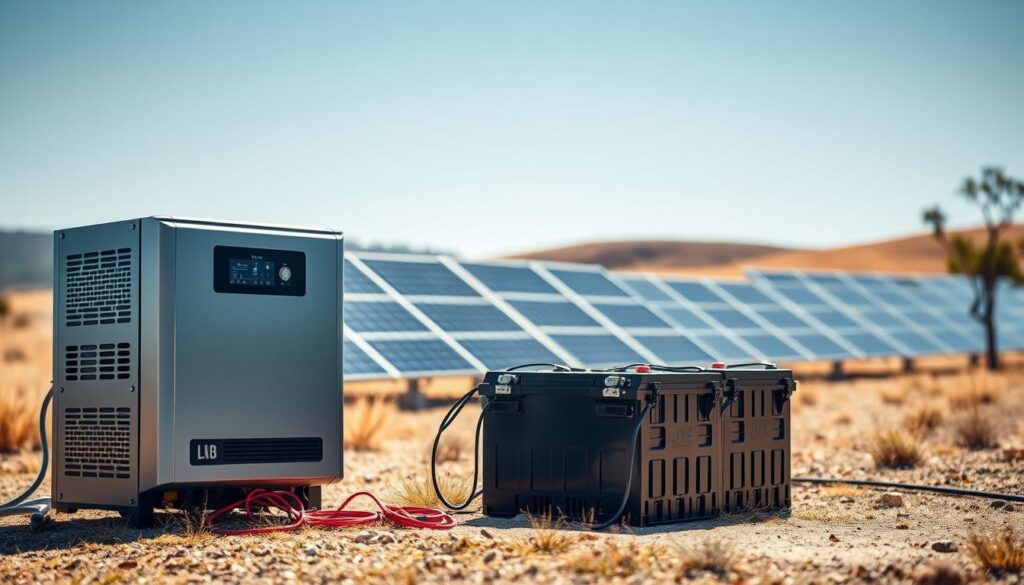
You have three main inverter types. Each choice affects your system’s flexibility and strength.
| Inverter Type | Primary Function | Best For | The Catch |
|---|---|---|---|
| Grid-Tie | Feeds solar power to the utility grid. Often requires grid presence to operate. | Slashing electricity bills in a grid-connected home. | Useless during a blackout. It shuts off for safety. |
| Off-Grid | Converts DC from batteries to AC, independent of any grid. | True off-grid cabins or backup systems. | Can’t easily integrate with grid power if available. |
| Hybrid | The multilingual maestro. Manages solar, battery storage, and can connect to the grid. | The ultimate flexible setup. Use solar first, then batteries, then grid as a last resort. | Higher upfront cost, but delivers unparalleled control and efficiency. |
For most, the hybrid inverter is the best choice. It’s flexible and future-proof, optimizing every watt.
The battery is the system’s heart. It’s not like AAAs. We’re talking lithium-ion here. Lithium Iron Phosphate (LiFePO4) is top for durability and safety, even in harsh climates.
Here’s why LiFePO4 is great for cold weather:
- Excellent Cold-Weather Performance: It keeps its capacity and charges better in cold than other lithium batteries.
- 10–15 Year Lifespan: It’s a long-term investment, not something to throw away.
- Safe Indoor Installation: Its stable chemistry means low fire risk, making it safe for garages or basements.
With efficient solar, a smart hybrid inverter, and a strong LiFePO4 battery, you’re not just buying parts. You’re building a strong, self-sufficient power system. For more on putting it all together, check out our guide to off-grid energy storage.
Maintenance Considerations
Welcome to the reality check. Your shiny new energy independence needs a lot of care. The panels and battery bank aren’t just decorations. They’re a microgrid that needs your attention.
Off-grid living means you can’t just forget about your system. It’s like a living thing that needs care. Stewardship is key here.
Your monitoring system is the brain of your setup. It shows how much energy you’re using and making. This isn’t just a gadget; it’s your power analytics dashboard.
Watching the energy flows can be fun. It turns you from a passive user into an active manager. You start to know exactly how your system is working.
Solar panels need to be cleaned. Dust, pollen, or bird droppings can block sunlight. Cleaning them is a simple task that makes a big difference.
The battery is the heart of your system. Even though it’s called “maintenance-free,” it needs care. Keeping it at the right temperature is key to its health.
Letting the battery get too hot or cold can harm it. It’s like giving it a good home. This is your job as a steward.
A failing battery can cause big problems. It might stop your electric pump. This can leave you without water. Your off-grid system is an ecosystem where one problem can lead to many.
So, forget the idea of “maintenance-free.” Being a good steward is hard work. It includes daily checks and cleaning. For more on this, check out mastering the daily operations of your system. A good microgrid isn’t just bought; it’s cared for.
Success Stories
Forget the doomscroll about energy crises. Let me tell you about a family in Montana who laughed when the grid went down. Their lights stayed on, their fridge hummed, and their Wi-Fi—crucially—remained live. This isn’t magic. It’s the quiet, daily victory of well-planned off-grid storage.
Success here isn’t a single finish line. It’s a spectrum. On one end, you have the weekend warrior. Their “homestead” is a camper van powered by a portable power station. It’s a micro-off-grid test lab, proving the concept works before you mortgage your future for 20 acres.
On the other end, you have the full-blown pioneer. But even that archetype has evolved. Modern energy independence isn’t about sheer grit alone. It’s about smart leverage. Take the Canadian family that used the federal Greener Homes Initiative grant to install solar panels coupled with a robust battery bank. They didn’t just slash their bills. They deleted a source of low-grade anxiety—the fear of the next outage, the dread of the next rate hike. Over 30,000 families have already used that program. That’s not an anecdote. It’s a data point.
The story gets bigger, and more interesting, when you look at the collective. As of 2023, Canada had over 280 off-grid communities and eco-villages. Think about that. That’s a living tapestry of collective intelligence, a network of real-world labs solving the same problem: how to live well, unplugged. These aren’t hermits. They’re engineers, gardeners, and philosophers running a decades-long beta test on sustainable living. And they’re passing.
What binds the van-lifer and the eco-village resident? It’s the shift from consumer to producer. It’s the profound satisfaction of meeting a fundamental need yourself. This is the pioneer spirit, updated with lithium-ion batteries and satellite-based solar maps. You can start small. A weekend camping trip with a serious power station is a gateway drug. It proves the feeling of energy independence is addictive.
So, let’s be clear. These stories are more than feel-good vignettes. They are operational proof. They demonstrate that off-grid storage works at every scale. It works for the family hedging against instability. It works for the adventurer seeking freedom. It works for the community building a resilience loop. The technology has moved from the fringe to the feasible. The dream isn’t just alive. It’s running a dishwasher in the middle of nowhere, completely on its own terms.
Common Pitfalls
Every journey to independence has its hidden challenges. We often stumble not because we fail, but because we underestimate the obstacles. The path to true remote power is filled with good plans that go awry due to miscalculations.
One common mistake is underestimating the power needs. You might forget about the espresso machine’s high power usage. This leads to a system that fails when you need it most. Getting an accurate energy audit is essential. It’s not just a suggestion.
Another mistake is ignoring local regulations. You might build your system, only to find out it’s not allowed. Zoning laws and utility policies are key to your freedom. Ignoring them can turn your dream into a costly legal issue.
The last mistake is making your system too dependent on one thing. This means all your power relies on one technology. A system without backup is vulnerable to failures. The wise approach is to have a backup for your backup. This makes all the difference between a good life and a hard one.
These mistakes are not about being careless. They are about missing important information. Being aware of these pitfalls can help you avoid them. Your journey to energy independence is not just about the technology. It’s also about being smart and prepared for the unexpected.