Let’s face a harsh truth. The device you’re using now is a tiny thermal danger. We’ve crammed the power of a small chemical plant into our pockets and power grids.
The National Renewable Energy Laboratory (NREL) has some eye-opening data. Scientists like Donal Finegan use X-ray vision to see lithium-ion batteries fail in slow motion. It’s like watching a blockbuster disaster film at a million frames per second.
The next big thing in energy storage is coming. It promises more power and longer life. But it’s got unknown actors like alkali metal anodes and solid electrolytes. Their failures are a whole new kind of disaster.
We don’t fully understand their kinetics, toxicity, or thermal reactions yet. Our old ways of hazard quantification might not work. Our need for battery safety has grown faster than our safety protocols.
This isn’t just scare tactics. It’s a clever look at the chemical drama inside every battery. The race for better storage is on. But are we writing the safety rules as we go?
Industry Standards
Reading compliance documents can be as exciting as watching paint dry. But in the world of battery energy storage, they are key. They help turn a reliable asset into a safe one. Industry standards are like traffic laws, needed but often ignored.
We deal with many acronyms like NFPA, UL, IAFC, and EPRI. These aren’t just words; they’re important knowledge. The U.S. Environmental Protection Agency (EPA) helps us find the right rules. It’s like having a guide to avoid big problems.

In the U.S., two documents are the foundation of BESS safety. They set the minimum compliance level for every project.
- NFPA 855, Standard for the Installation of Stationary Energy Storage Systems (2023): This sets rules for where and how to install systems. It covers safety and fire prevention.
- UL 9540 and UL 9540A (revised 2025): This standard tests the system and its cells for safety. Passing it shows a system’s engineering quality.
These standards are backed by groups like the National Fire Protection Association (NFPA). They write the codes. The International Association of Fire Chiefs (IAFC) responds to incidents. The Electric Power Research Institute (EPRI) does the research. It’s a safety ecosystem.
Here’s a key fact: the failure rate of BESS has decreased. This is thanks to better quality and design. The danger narrative is changing to one of growth and safety.
How do we keep up with fast innovation and safety rules? Standards are not limits but a safety grammar. They help everyone work together. Innovation is about making things better within these rules.
Safety is more than just following rules. It’s about understanding the code’s spirit. The EPA and NFPA documents are your guides. For more on safety, check out this OSHA publication. Compliance is the start. Building a culture that respects and innovates within it is the real goal.
Safe Design and Installation
A “Safety First” sticker on a poorly designed battery rack is like putting a band-aid on a faulty circuit—it’s a confession of failure, not a plan. True fire prevention isn’t an accessory you bolt on later. It’s the foundational grammar of the entire system, embedded from the very first sketch on the napkin.
Will Manchas from Lightsource bp calls safety the “yardstick” for execution quality. I see his point. When safety is a core design parameter, it protects asset value, avoids catastrophic delays, and enables predictable performance. You’re not just building a facility; you’re architecting risk out of existence.
This is the art of optimistic pessimism. You hope your system runs flawlessly for decades. But you design as if it won’t. You engineer elegant solutions for failures that may never happen. That’s not paranoia; it’s the highest form of professional responsibility.
Let’s make the philosophy practical. The difference between reactive and proactive design isn’t subtle; it’s the chasm between a news headline and a non-event.
| Aspect | Reactive Approach | Proactive (Safe Design) Approach |
|---|---|---|
| Core Philosophy | Comply, then hope. | Design for failure. Assume things will go wrong and engineer the response into the blueprint. |
| Risk Management | Adds safety features as problems arise. | Bakes fire prevention and mitigation into site layout, spacing, and material selection from day one. |
| Cost Perspective | Views safety upgrades as expensive overruns. | Sees integrated safety as an upfront investment that protects against monumental future losses. |
| Stakeholder Engagement | Informs first responders after construction. | Engages local fire department during the design phase for emergency planning. |
Now, translate that table into a gritty, real-world checklist. The EPA’s guidance is brilliantly unsexy. First, navigate the maze of local zoning and permitting. This isn’t red tape; it’s the community’s first layer of defense. Second, consult the latest industry standards—not just the ones from last year.
Third, spec the tech. Remote sensors and thermal monitoring aren’t just “nice to have.” They’re the central nervous system of your facility, providing early warnings long before a smolder becomes a spectacle. Fourth, and this is critical, bring local first responders into the conversation early. Give them the blueprints before the concrete sets.
What if the Moss Landing incident could have been prevented not by a faster firetruck, but by a smarter battery management system designed to isolate a thermal runaway at its inception? That’s the power of design. It’s where intellectual analysis meets the concrete world of conduit, code, and comprehensive operational safety protocols.
In the end, a well-designed facility is its own best defense. It enables predictable performance and asset value because the major risks were solved on paper, long before they could ever manifest in steel and smoke. That’s fire prevention you can build on.
Emergency Response
Dealing with a lithium-ion battery fire is not about being a hero firefighter. It’s about careful planning to contain the fire. It’s a mix of quick thinking and a detailed plan, like in a sci-fi movie.
One key rule is to let the fire burn. This doesn’t mean giving up. It’s about knowing that a lithium-ion fire is a chemical reaction that can’t be stopped easily. Trying to put it out completely is like trying to stop an idea with a squirt gun—it’s pointless and messy. The goal is to keep it away from other things, not to stop it completely.
First, you need to wear Personal Protective Equipment (PPE) and Self-Contained Breathing Apparatus (SCBA). It’s like wearing a spacesuit to deal with a problem in your own area. Then, you create a safe area around it. The EPA says you need at least 330 feet in all directions. This is a big circle, bigger than a football field. Everyone needs to be upwind, and you should think about moving people away quickly. Time is running out.
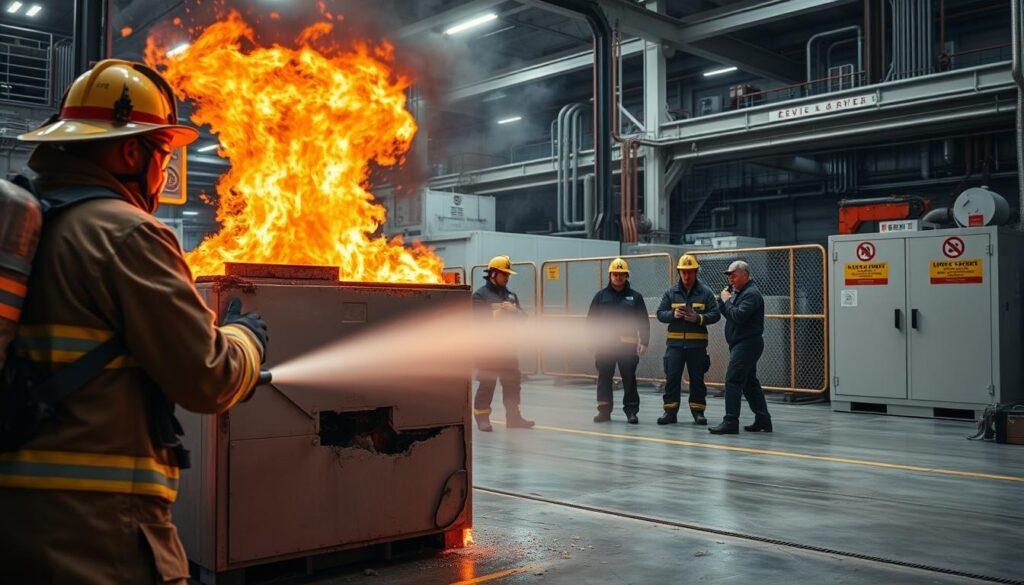
While fighting the fire, you also have to worry about toxic gases. These gases are harmful and can spread far. This is where fire prevention turns upside down. You’re not just fighting a fire; you’re also dealing with a dangerous chemical spill.
| Toxic Emission | Primary Threat | Response Imperative |
|---|---|---|
| Hydrogen Fluoride (HF) | Severe respiratory damage, bone degradation; highly corrosive. | Mandatory SCBA. Air monitoring is non-negotiable. |
| Hydrogen Cyanide (HCN) | Rapid-acting poison that interferes with cellular oxygen use. | Extreme caution for responders; dictates extensive evacuation zones. |
| Hydrogen Chloride (HCl) | Corrosive to eyes, skin, and respiratory tract; forms hydrochloric acid in moisture. | Requires protective suits and careful decontamination procedures. |
So, you keep the fire wet to cool it down, not to put it out. This way, you prevent it from spreading. All the while, you check the air for harmful gases. After the fire is out, you have to clean up the contaminated water. This shows why good public safety storage is key.
The real risks are not just theories. Look at the 7-day Gateway energy storage fire in California or the precautionary evacuation near Moss Landing. These are real-life tragedies for communities and first responders. They show the huge costs when battery safety fails.
In the end, this is a big test. Our smart designs and plans are put to the test in this crisis. It’s a reminder that we’re always up against chemistry’s most dangerous forces.
Regulatory Updates
The rulebook for energy storage was never meant to be final. Compliance is always changing. Regulators are trying to keep up with new technology.
Old standards were like judging a movie by its trailer. Now, we use artificial intelligence to simulate the whole movie. At NREL, AI is predicting battery failures before they occur. This change moves from reacting to preventing safety issues.
These AI models will guide updates to NFPA 855 and UL 9540. Future compliance will focus on understanding complex risk scenarios. The data helps bridge the gap between lab tests and real-world challenges.
Even with these changes, today’s rules are not forgotten. Legal frameworks like WHMIS programs are the foundation. They provide the structure for the new algorithms.
The future of safety compliance might be written by algorithms, not just committees. The best way to manage risk is to outthink it completely.