On January 8, 2026, Illinois fundamentally shifted its utility landscape. The state enacted the Clean and Reliable Grid Affordability Act (CRGA), also known as Senate Bill 25. Governor JB Pritzker signed the legislation, which officially takes effect on June 1, 2026. Ultimately, this law marks a decisive pivot toward a resilient, decentralized power infrastructure.
The new law builds upon foundational frameworks from the Climate and Equitable Jobs Act (CEJA) of 2021 and the Future Energy Jobs Act (FEJA). Specifically, it addresses the dual challenges of escalating electricity prices and grid vulnerability. The state is aggressively targeting battery storage expansion and consumer-level energy generation. Consequently, Illinois is taking concrete steps to combat massive price volatility. Regional grid operators and surging power demand from expanding data centers largely drive this volatility.
Tracking Illinois’ largest clean energy projects in 2026 offers a real-time glimpse into this transition. It shows exactly how this massive influx of capital is moving from policy mandates into active construction.
A Strategic Mandate for Three Gigawatts of Storage
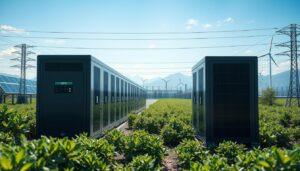
Perhaps the most ambitious component of the CRGA is its directive for the Illinois Power Agency to oversee the procurement of three gigawatts (3,000 megawatts) of utility-scale energy storage by December 31, 2030. This statutory requirement elevates Illinois to the thirteenth state nationwide to adopt a dedicated energy storage mandate.
Deploying grid-scale batteries at this volume is engineered to capture excess renewable generation from wind and solar assets, subsequently discharging that power during peak demand intervals to offset the reliance on expensive, high-emission fossil fuel peaker plants.
To initiate this rapid scaling, the state has already mapped out a competitive procurement process required to be executed by August 2026. The initial phase focuses on securing just over a gigawatt of standalone storage capacity, ensuring that grid enhancements are distributed strategically across the state’s distinct regional transmission organizations.
| Procurement Region | Target Capacity (MW) | Primary Grid Operator |
| MISO Zone 4 (Central/Southern IL) | 450 MW | Midcontinent Independent System Operator |
| PJM ComEd Area (Northern IL) | 588 MW | PJM Interconnection |
The Rise of Virtual Power Plants and Grid Democratization
Beyond large-scale utility infrastructure, the legislation democratizes energy distribution. It mandates the creation of Virtual Power Plants (VPPs). These progressive utility programs will aggregate distributed energy resources into a unified, dispatchable network. These resources include residential solar panels, home battery systems, smart thermostats, and electric vehicle chargers.
VPPs financially compensate households and businesses for harnessing their demand flexibility. As a result, they transform everyday consumers into active grid participants.
This shift from a passive consumer model to an integrated, responsive grid will yield unprecedented economic benefits. State officials project that these combined grid efficiency measures will save Illinois ratepayers roughly $13.4 billion over the next two decades. These profound financial savings reinforce the state’s broader objective. Ultimately, Illinois wants to decouple economic growth from utility rate inflation.

Empowering Consumers and Elevating Solar Capacity
The CRGA introduces structural reforms designed to protect individual energy rights. Additionally, it accelerates localized generation. A newly established Solar Bill of Rights guarantees protections for citizens served by municipal and cooperative utilities. Specifically, they will face no arbitrary prohibitions against installing rooftop solar arrays.
For community-driven projects, the legislation doubles the maximum permissible size of community solar installations to 10 megawatts. Illinois already ranks fifth nationally in community solar development. Therefore, this expansion is poised to attract substantial new investment into local energy infrastructure.
Equity remains a central pillar of the legislation’s execution strategy. The act mandates a tripling of the minimum required utility expenditure for income-qualified energy efficiency programs. This guarantees that 25% of total spending directly benefits vulnerable communities. Furthermore, the legislation directs authorities to evaluate a new “Storage for All” initiative. This is modeled after successful state clean energy programs. The program aims to colocate battery infrastructure alongside income-eligible solar projects. Consequently, it bridges the accessibility gap for cutting-edge energy technologies.
Modernizing the Regulatory Landscape for a Clean Energy Future
To effectively manage this complex transition, the CRGA revamps state-level energy planning. It launches a formalized Integrated Resource Planning (IRP) process. Furthermore, it creates the Office of Energy Modeling. These institutions are tasked with accurately forecasting energy demand. This includes analyzing the mounting strain from industrial data centers. They must also proactively align clean energy procurement targets to meet those needs.
Additionally, the legislation subtly shifts the state’s baseload power strategy. It lifts an existing moratorium on the development of large nuclear reactors. This acknowledges the necessity of a diversified, zero-carbon generation portfolio.
Illinois is securing its economic and environmental future by harmonizing ambitious storage targets with protective consumer legislation and advanced grid modeling. The state has firmly positioned its regulatory framework as a blueprint for comprehensive grid modernization. Ultimately, this proves that sustainability and affordability can advance in tandem.