Remember when renewable power was seen as too expensive? Well, turbine prices have dropped by 50% from 2008. Now, they cost about $850-$950 per kilowatt.
But there’s a twist: the cost of installing wind projects varies like real estate. Land-based projects are like affordable suburbs, costing $1,200-$1,800/kW. Offshore projects are like luxury homes, priced at $3,500-$4,000/kW.
Maintenance costs are like HOA fees, averaging over $40/kW annually for land-based projects. Looking at the complete economics, it’s clear why this sector is so attractive.
The levelized costs tell an even more interesting story. Land-based installations cost $39/MWh, like a bulk buy. Offshore projects cost $95/MWh, like a premium product. It’s like choosing between a reliable Toyota and a luxury Tesla.
Trends in LCOE
If wind energy’s cost were a stock, we’d be seeing the next Amazon. The numbers show that wind costs are beating many tech startups. They’re delivering returns that would make Warren Buffett proud.
Remember when renewable energy was expensive? Those days are over. Today, onshore wind projects are making electricity cheaper than fossil fuels.
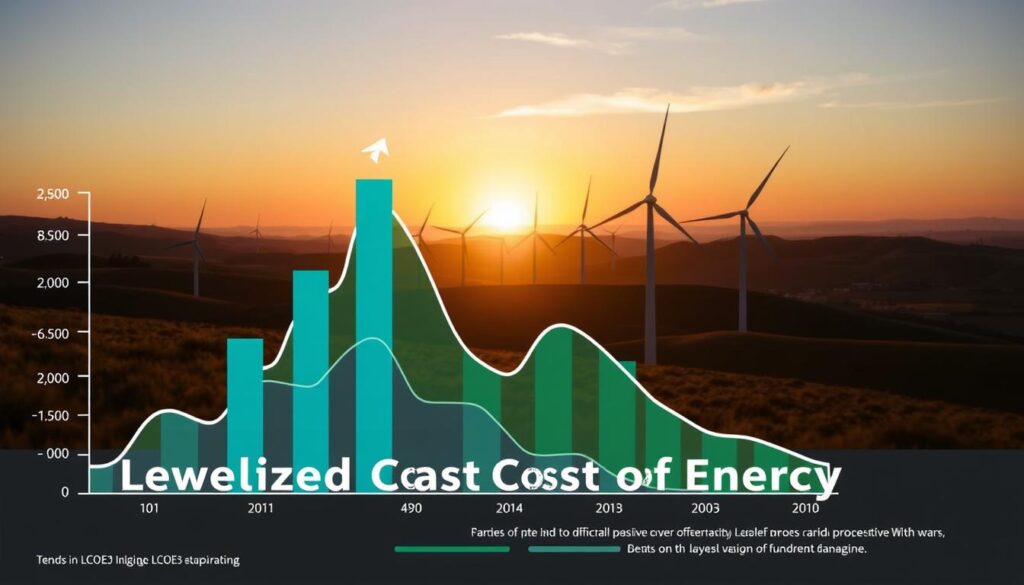
The real story is where wind costs are going. We’ve seen prices for wind power drop below 2 cents per kilowatt-hour. That’s not just competitive; it’s disruptive pricing in an industry known for slow change.
What’s fascinating is the stability of wind energy. While fossil fuel prices swing wildly, wind offers predictability. Projects can secure fixed prices for over 20 years, making them a safe bet against market ups and downs.
This isn’t just about cheap electricity. It’s about changing the rules of energy economics. The LCOE revolution means we’re comparing financial models, not just energy sources. One offers wild rides, while the other provides steady, reliable returns that make CFOs smile.
The beauty of these trends? They’re self-reinforcing. As technology improves and more projects are built, costs keep falling. It’s a virtuous cycle that every industry dreams of but few achieve. Wind energy isn’t just competing on price anymore. It’s setting the new benchmark for affordable, reliable power.
Policy Incentives and Subsidies
Let’s be honest – even the most promising wind projects need government support to truly take flight. The policy landscape for wind energy isn’t just helpful; it’s the economic jet fuel that transforms turbines from theoretical concepts into spinning realities.
Think of these incentives as the ultimate cocktail party for renewable energy. You’ve got tax credits that would make even Wall Street bankers blush, feed-in tariffs that guarantee profitability, and renewable energy targets creating built-in demand. It’s like having a guaranteed date for the prom before you even ask.
The real star of this show? Power Purchase Agreements (PPAs). These contracts are the financial security blankets that let developers sleep soundly, knowing they’ve got locked-in buyers at fixed prices. It’s dating with a prenup, but for electricity generation.
Then there’s net metering – the policy that turns your wind turbine into both producer and consumer. It’s the ultimate energy multi-tasker, allowing excess power to flow back to the grid while cutting your electricity bill. Talk about having your cake and eating it too.
These aren’t just nice-to-have perks; they’re essential components that have propelled wind from alternative curiosity to mainstream contender. The current incentives structure includes:
- Production Tax Credits – per-kilowatt-hour tax breaks that reward actual energy generation
- Investment Tax Credits – upfront cost reductions that make projects more financially viable
- State-level mandates – renewable portfolio standards creating guaranteed markets
- Accelerated depreciation – allowing faster write-offs on capital investments
The beauty of these subsidies isn’t just their immediate impact. They create a virtuous cycle where initial support leads to technological improvements, which drive down costs, making future support less necessary. It’s the economic equivalent of training wheels – eventually we won’t need them, but they’re absolutely essential for getting us rolling.
What makes these policy incentives effective is their timing. They’re structured to provide maximum support during the riskiest phases of development, then gradually phase out as projects become commercially viable. It’s like teaching a kid to ride a bike – you start with full support, then slowly let go as they find their balance.
The current landscape offers something for everyone. Utilities get clean energy commitments fulfilled, developers get financial certainty, and communities get economic development. Mother Nature gets a break from carbon emissions. Everybody wins.
These incentives aren’t just about making wind energy possible; they’re about making it irresistible. When the numbers work, the turbines spin. And right now, thanks to smart policy design, the numbers are working better than ever.
Market Growth Drivers
If wind energy were a stock, I’d invest everything I have. The global wind market is booming, like Tesla in its early days. It’s expected to grow from $97.05 billion in 2024 to $141.09 billion by 2030, at a 4.9% annual rate.
Asia Pacific leads the market, with a 40.71% share. The US market is also growing fast, showing America’s ability to innovate.

Onshore wind dominates with a 75.52% share, thanks to its simplicity. Utility-scale applications have an 83.5% share, focusing on large-scale energy production.
Several factors are driving this growth. Technological advancements, government support, and environmental concerns are key.
- Technological advancements making turbines more efficient than a German engineer
- Government policies that are more supportive than a therapist during tax season
- Environmental concerns growing faster than my inbox during election season
Technological improvements have greatly reduced costs. Turbines now generate more power with less wind. Maintenance costs are dropping, and efficiency gains are impressive.
| Market Segment | 2024 Share | Growth Driver | Regional Leader |
|---|---|---|---|
| Onshore Wind | 75.52% | Cost Efficiency | Asia Pacific |
| Offshore Wind | 24.48% | Technology Innovation | Europe |
| Utility Scale | 83.5% | Economies of Scale | North America |
| Distributed Generation | 16.5% | Grid Resilience | Asia Pacific |
This analysis shows a shift in energy production. We’re moving towards a cleaner, cheaper, and smarter energy system.
The numbers and momentum are clear. Technological innovation, economic incentives, and environmental urgency drive explosive growth. The wind market is shaping the energy future before our eyes.
Investment Risks and Returns
Investing in wind energy is like playing chess with Mother Nature. The risks are real. Grid integration challenges are like planning Thanksgiving dinner.
Location is key for returns, not just prime real estate. A solid market analysis shows these hurdles. It reveals how project economics change with size, location, and wind.
Getting permits is like waiting for a saint. Managing stakeholders is like solving a UN-level problem.
But the returns are worth it. They boost local economies and lower electricity rates. Tourism increases as people want to see the turbines.
This isn’t a quick way to make money. It’s a long-term investment. A market analysis proves it: wind energy is a smart choice for a greener future.