Do you remember those summer evenings when the sun went down? But the pavement was warm under your feet? It’s like nature’s own heat battery, quietly working away.
This simple idea is at the heart of a big change. What if we could use this idea on a big scale? That’s what Thermal Energy Storage, or TES, is all about.
Think of TES as a smart energy manager. It grabs heat (or cold) when it’s easy to get—like from solar panels during the day. Then, it stubbornly keeps it for when we really need it.
This isn’t about making more power. It’s about using what we already have better. Our renewable energy system has a timing problem. TES fixes this by turning waste into useful energy, solving a big clean energy challenge.
Key Technologies
Forget one-size-fits-all. The thermal storage world is full of different solutions. Each one has its own unique features. It’s like a master mechanic’s workshop, where the right tool is chosen for the job.
Let’s look at the main ways to store heat. Engineers use three main methods. They are like a classic trilogy of thermal storage.
- Sensible Heat Storage: This method heats up a material, like water or concrete. It raises the material’s temperature. It’s reliable but takes up a lot of space.
- Latent Heat Storage: This method uses Phase Change Materials (PCMs). These materials absorb a lot of energy as they melt. They store energy without a big temperature change. It’s like magic.
- Thermochemical Storage (TCM): This method stores energy in chemical bonds. It’s reversible and stores energy for a long time. It’s the most complex but has huge benefits.
Now, let’s talk about heat batteries. This is where thermal storage gets clever. We’re not just talking about hot water tanks anymore. We’re talking about turning electricity into heat with advanced technology.
Companies like Rondo Energy and Electrified Thermal Solutions are making thermal energy storage cool. They use cheap, excess renewable electricity to heat bricks. These bricks store thermal energy for industrial processes.
Antora Energy is like alchemy. They heat solid carbon blocks to 2,400°C. They capture the light these blocks emit and turn it back into electricity. It’s amazing.
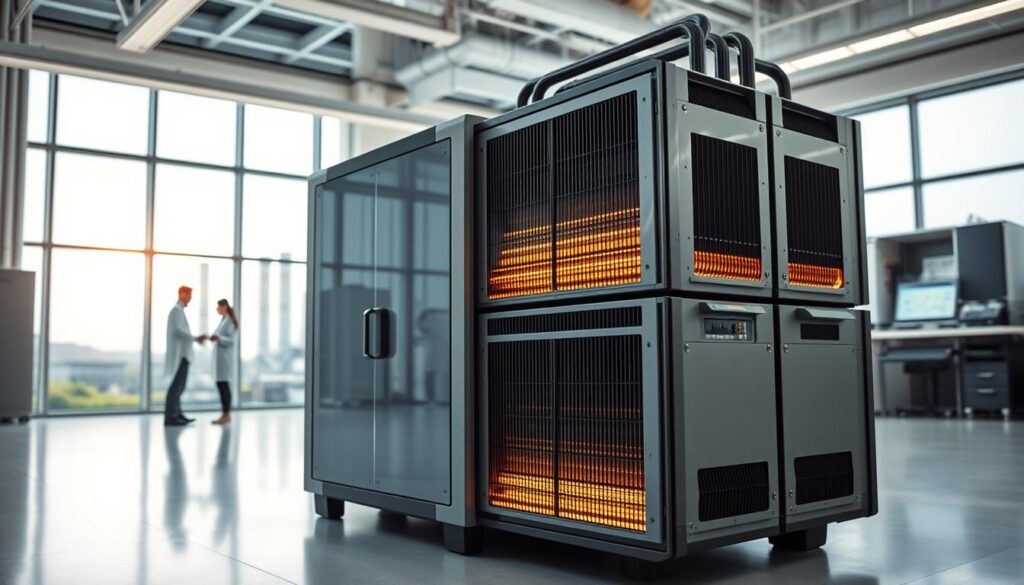
Other companies are also creative. Magaldi Group uses a fluidized sand bed for efficient storage. I-Tes and others are working on advanced PCM and TCM solutions.
Molten salt is also important. It’s used in concentrated solar power plants. New systems are making it more versatile for storing energy.
Each technology has its own way of storing heat. From simple heated rock to complex chemical reactions, it shows human creativity. For more details, check out this comprehensive review of thermal energy storage.
So, when someone talks about “heat battery,” think of glowing carbon, electric bricks, and molten salt. The details are fascinating.
Industrial & Residential Applications
If thermal storage were a superhero, it would wear a hardhat and a smart thermostat. It works well in both industrial settings and homes. It’s a hero in two different worlds.
In heavy industries like steel and chemicals, thermal storage is key. It helps reduce the use of fossil fuels. This is because heat is essential for these processes.
Imagine using waste heat from a blast furnace. Or, think of a thermal battery that can heat up to 1,000°C. This cuts down on natural gas use at night, thanks to laws like the U.S. Inflation Reduction Act.
Now, let’s look at homes and businesses. Here, thermal storage is a smart helper. It fits well with large district energy systems.
Companies like Vicinity Energy use big thermal storage tanks. They turn renewable energy into steam for whole city blocks. Projects in Denmark show how this works on a smaller scale.
In smaller settings, like Scotland’s Blar Mhor, Sunamp thermal batteries are making a difference. They lower energy costs and make homes more independent. It’s like making ice at night to cool buildings during the day, but modern.
Our sources explain this through a STEPS lens (Social, Technological, Economic, Political, Spatial). It’s not just about the tech.
- Social: Projects like Blar Mhor offer affordable, green heating.
- Technological: Innovations like Malta Inc.’s system turn old coal plants into thermal storage centers.
General uses are vast. It can control temperatures in big buildings or heat food precisely. The chance to use residential thermal energy storage with local grids is exciting for research.
So, how do these two areas compare? Let’s look at the differences.
| Application Sphere | Primary Driver | Scale & Complexity | Key Example |
|---|---|---|---|
| Industrial | Process decarbonization, cost savings | Gigawatt-scale, high-temperature (500°C+) | Rondo Heat Batteries for industrial heat |
| Residential/Commercial | Energy bill reduction, grid flexibility | Kilowatt to Megawatt-scale, low to medium temperature | Sunamp thermal batteries in housing projects |
| District Energy | Urban decarbonization, efficiency | City-block scale, integrated systems | Vicinity Energy’s eSteam™ networks |
In conclusion, thermal storage is a game-changer for both industries and homes. It’s a powerful tool for reducing carbon emissions in factories and a smart way to save energy in buildings. This technology is amazing because it works in both worlds, showing that a strong grid needs both strength and finesse.
Seasonal and Daily Shifting
Imagine a battery that stores summer’s heat for a cold winter morning. Welcome to seasonal thermal shifting. Unlike your phone battery, these systems last for months. It’s not just energy management; it’s time travel.
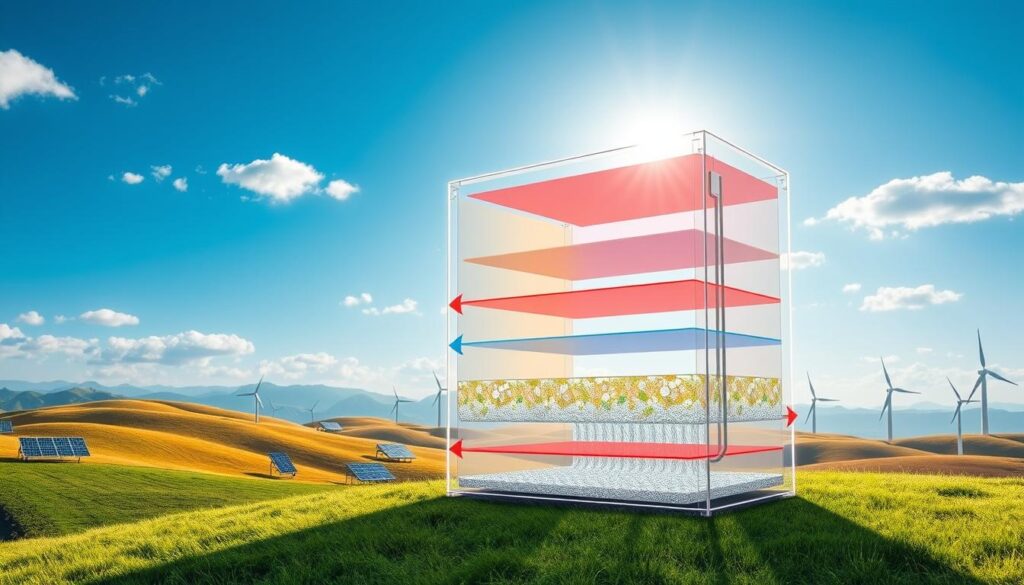
Seasonal shifting is a game-changer for energy systems. It captures summer’s solar thermal energy and stores it underground. Then, in winter, it releases this energy when it’s most needed. It’s like canning sunlight.
In Toronto, the Enwave Deep Lake Water Cooling system uses Lake Ontario’s cold water. It cools downtown skyscrapers all summer. This is energy arbitrage on a huge scale, turning a natural resource into a strategic asset.
For daily use, TES is a grid favorite. Modern heat batteries shine here. They’re charged at night when wind turbines are free and electricity is cheap. This is off-peak power that would be wasted.
In the morning rush, these batteries release warmth. This reduces demand and prevents the need for expensive, polluting plants. The same logic applies to cold storage, making ice at night for air conditioning.
The benefits are huge:
- Grid Strain Reduction: TES reduces congestion and delays grid upgrades.
- Economic Efficiency: It uses cheap, abundant off-peak power, saving money.
- Emissions Cuts: It displaces fossil fuels used for peak heating and cooling.
A detailedstudy on thermal energy storage efficiencyshows these systems are efficient. They’re a smart investment for a cleaner grid.
While lithium-ion batteries focus on the now, grid-scale heat batteries play chess. They outmaneuver the energy market, using time as our most valuable asset.
Major Projects
Theory is cheap. But concrete and political will are what really test thermal storage.
In Rønne, Denmark, Hyme Energy is creating the world’s first molten salt system with hydroxide. It’s a test site on Bornholm, making old plants work for a green grid.
Crossing the Atlantic, Vicinity Energy is making Boston’s steam network carbon-free. They’re using thermal brick and lava rock storage for this big change.
In Scotland’s Highlands, the Blar Mhor project is making homes affordable. It uses Sunamp thermal batteries with heat pumps to fight energy poverty.
Malta Inc. has a poetic plan. They’re turning old coal plants into electro-thermal molten salt storage. It’s a new life for retired plants.
Brenmiller’s rock-based system is at an Enel plant in Italy. It shows a blueprint for the world. These projects are strong arguments for change.
They show that thermal storage is both possible and cost-effective. The sector is growing fast, as recent analysis shows. This is a revolution in how we manage heat, not just burning it.