Let’s cut through the hype. The most reliable “battery” isn’t a sleek slab of lithium. It’s a mountain, two lakes, and clever plumbing. This is pumped hydro, using gravity’s power.
It’s like the grid’s ultimate shock absorber. It has two reservoirs, one high and one low. They work like a huge capacitor.
When the sun shines and the wind blows, we pump water uphill. This stores energy, lifting mass against gravity.
When demand is high and everyone wants AC, we release the water. It rushes down, spinning a turbine to make electricity. It’s like a hangover cure, using cheap energy at night for peak demand.
This cycle is why they call these systems water batteries. The efficiency isn’t 100%, but it’s the most reliable for scale. It’s all about the power of gravity.
Project Examples Worldwide
The world of energy storage is changing, thanks to old landscapes and gravity. Today, hydroelectric power isn’t just about big dams. It’s about using water as a battery. Let’s explore this.
In Virginia, USA, the Bath County Pumped Storage Station is a giant. It has a huge 3,003 MW capacity. When power demand goes up, it can quickly increase to 100% power. It shows how big ambition can work in America, using two big reservoirs to help the PJM grid.
Next, we head to the Swiss Alps. Here, precision is key. The Nant de Drance facility is a marvel of engineering. It’s built into a mountain, using a huge height difference between its reservoirs. This plant is a great example of how countries can work together, balancing power grids in Switzerland, France, and Italy.
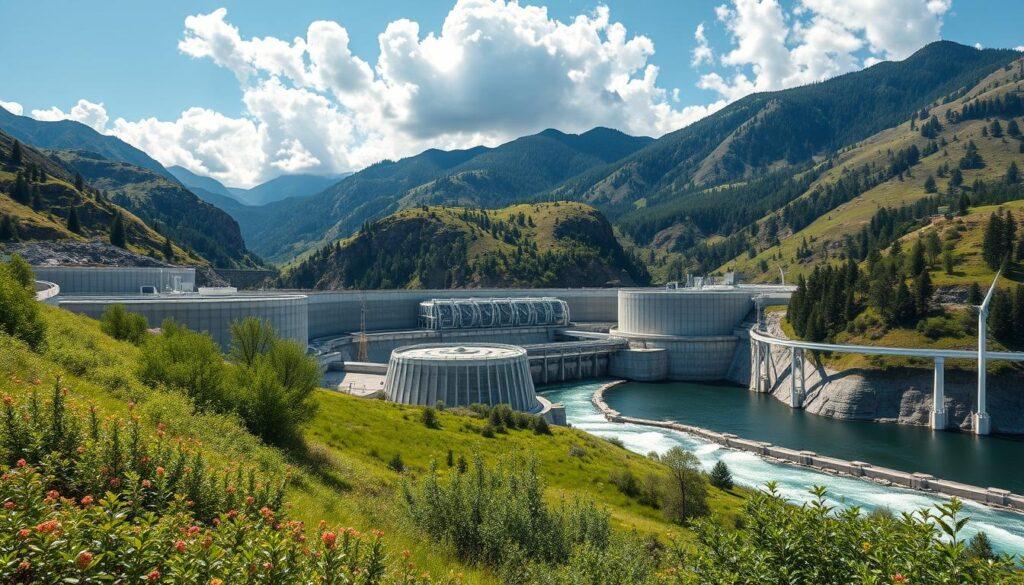
In the West, tech was improved, but China is taking it to a new level. They aim for a 120 GW target for pumped storage. China is turning its mountains into a huge source of power. It’s a bold plan based on gravity.
Europe is also waking up. New rules make it profitable to be flexible. Old projects are being updated, and new ones are being planned. This is a market-driven boom, showing that good policies can help everyone.
In Africa, hydroelectric projects are about survival. The Kariba Dam Rehabilitation is a key effort. It’s not just an upgrade; it’s a lifeline for millions.
| Project | Location | Key Feature | Scale / Impact |
|---|---|---|---|
| Bath County | Virginia, USA | Gigawatt-scale rapid response | 3,003 MW; Grid stability for PJM region |
| Nant de Drance | Swiss Alps | High-head, cross-border collaboration | 900 MW; Balances Swiss, French, Italian grids |
| China’s National Program | China | Aggressive capacity expansion | Target: 120 GW; Topography as strategic asset |
| Kariba Dam Rehabilitation | Zambia/Zimbabwe border | Critical infrastructure security | Secures power & prevents disaster for millions |
Each project teaches a unique lesson. Bath County shows the power of big scale. Nant de Drance is a lesson in efficient engineering. China’s push is about industrial might. Africa’s efforts are about urgent needs.
The common thread is elevation is the new currency. Countries are looking at their hills and mountains for energy. This global shift is creating a new league of world’s largest pumped storage facilities. It’s a mix of politics, engineering, and physics. The future of grid stability is looking up.
Environmental Impact
Looking at the pumped hydro environmental impact is like reviewing a company with a troubled past. It’s trying to change its image to be more eco-friendly. But, its past actions are hard to forget.
Early projects had big environmental costs. They flooded valleys, harming aquatic ecosystems and fish migration. They also changed sediment flows, affecting downstream health. On land, communities were moved, and habitats were broken.
The industry used to say the benefits of clean energy were worth the environmental damage. But, this view is no longer accepted.
Now, the industry must follow strict rules to be seen as sustainable. The San José Declaration sets out these rules. The Hydropower Sustainability Standard guides how to meet these standards.
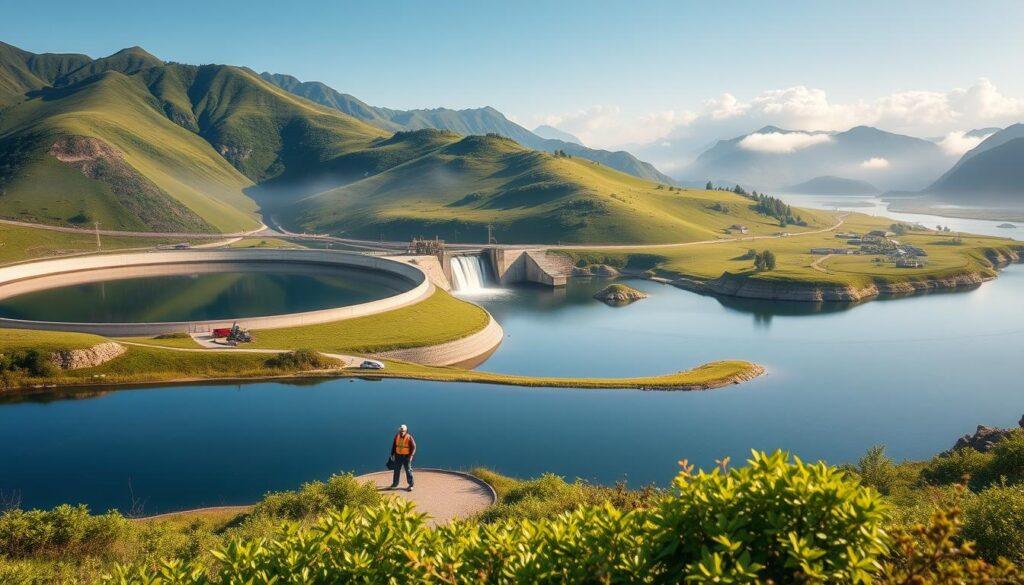
Today, the industry focuses on careful planning. First, it does detailed environmental impact assessments. These studies look at water quality and noise pollution.
Second, it creates water management plans. These plans make sure water flows are right and reservoirs are used wisely, even in droughts.
Third, it works closely with communities. This means more than just listening to them. It’s about working together to create jobs and improve local areas.
This approach is key to the project’s success. It shows that the project must be good for the community to work.
Ironically, pumped hydro is now facing challenges from climate change. It needs steady water cycles to work well. But, droughts and floods can harm it. To solve this, it’s exploring new ways, like using solar panels to reduce water loss.
| Historical Impact | Modern Mitigation | Key Driver |
|---|---|---|
| Ecosystem disruption & habitat loss | Mandatory Environmental Impact Assessments (EIAs) & biodiversity offsets | Regulatory compliance & sustainability standards |
| Community displacement with limited recourse | Formalized community engagement plans & benefit-sharing agreements | Social license to operate (San José Declaration) |
| Water use managed for power generation alone | Integrated Water Resource Management (IWRM) plans for multi-use | Climate resilience & shared resource needs |
| Vulnerability to climate extremes treated as an externality | Advanced forecasting & hybrid system design (e.g., hydro-solar) | Risk management & asset protection |
The story of pumped hydro is complex. It’s not just about being green. It’s about being open, adaptable, and responsible. The industry is on a path to redemption, but it’s under close scrutiny.
Costs and Benefits
Building a pumped hydro facility is like building a medieval cathedral. It’s a huge upfront investment meant to last for centuries. The cost is shocking, like financing a giant battery.
The economics are interesting. The high initial cost gets spread out over a long time. We’re talking 50 to 100 years. It’s like a fine wine that gets more valuable over time.
Understanding this balance sheet is key. It’s not just about making money from energy. These facilities offer many services, making them valuable.
| Component | Description | Key Metric | Challenge | Opportunity |
|---|---|---|---|---|
| Capital Costs (Capex) | Civil works, turbines, tunnels, and reservoirs. The “cathedral” phase. | $1,500 – $2,500 per kW; $100 – $150 per kWh | Extreme upfront intensity, long lead times (5-10 years). | Long-term asset with zero fuel cost. Lifespan measured in decades. |
| Operational Profile | Day-to-day running costs and performance. | Round-trip efficiency: 70-80%; Low O&M (~2% of capex/year) | Site-specific geology can increase complexity. | Highly efficient, low-margin operation once built. |
| Revenue Streams | Multiple ways to make money from the same asset. | Varies by market | Dependent on volatile energy prices and market rules. | Capacity payments, energy arbitrage, and lucrative ancillary services (frequency regulation, black start). |
See that last row? Ancillary services are the high-frequency trading of the energy world. While energy arbitrage is the slow, steady bassline, selling grid stability and instantaneous response is the profitable lead guitar solo. This multi-revenue model is what makes the economics sing.
But here’s the rub: a brilliant engineering and financial model can be torpedoed by a Byzantine policy labyrinth. Market design is everything. Does the market value capacity for reliability? Does it pay for fast frequency response? If the rules don’t recognize the full suite of benefits, the project is dead in the water.
This is why the smart money is increasingly looking sideways, not just at greenfield sites. Modernizing existing dams and facilities is often the cheapest “new” capacity you can find. It’s the ultimate asset management hack. You’re leveraging sunk costs and existing infrastructure, dodging the worst of the permitting quagmire.
To unlock this, financing models need to evolve. They must reflect the decade-long lead times. Contract frameworks, like the FIDIC Emerald Book for hydropower, are emerging to de-risk these behemoth projects for private investors. It’s about making the capital marathon bankable.
So, when you tally the final costs and benefits, don’t just look at the quarterly returns. Look at the grid resilience. Look at the energy security for your grandchildren. The payoff isn’t just in dollars; it’s in a stable, clean, and secure grid for the long haul. Now that’s a return on investment.
Modern Upgrades
Forget the old image of a big, concrete dam. Today’s pumped hydro is getting a high-tech makeover. It’s not just about storing water anymore; it’s about storing smart ideas.
Now, turbines can adjust their speed to match the grid’s needs. This makes them more efficient. Hybrid systems combine water batteries with lithium-ion and green hydrogen. It’s a new way of thinking.
The magic happens in the digital control room. AI predicts river flows, and digital twins simulate entire plants. This smart modernization and renewal boosts flexibility, safety, and life of hydroelectric assets.
Old pumped storage tech has learned new tricks. It’s now the grid’s smartest battery, ready for a future full of ups and downs.